Cut and fill, building pads, slope correction, and drainage grades. Shot to elevation, compacted to hold.
Site grading is the earthwork that reshapes a piece of ground to a set of planned elevations before anything gets built on it. Soil is cut from the high spots, moved into the low spots, and compacted so the finished surface sits where the plan says it should and stays there through the first few freeze-thaw cycles.
Every grade on a site is doing one of two jobs: carrying a load, or moving water. A building pad has to hold a slab without settling. A lot has to shed rain to a ditch, a swale, or a storm inlet instead of toward a foundation. Most of what goes wrong on a finished property traces back to one of those two grades being off by a few inches.
People use "site grading" for two different scopes. On a construction project it means large-scale earthmoving to engineered elevations, worked from a civil plan and survey stakes. On an existing property it usually means regrading a yard or a lot to fix water that is going the wrong way. J.E. Excavating & Grading does both, out of Leslie, MI, across roughly a 50-mile radius, with Jarod running the work himself.
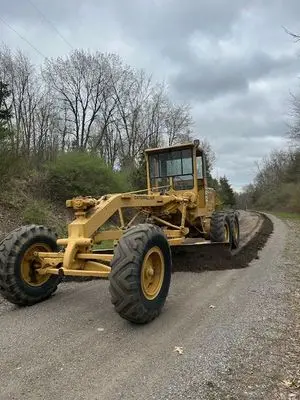
Most jobs use several of these together. A pole barn site is usually clearing, rough grading, pad build-up, and a finished slope away from the doors, all in one trip.
The bulk earthmoving stage. Topsoil and organic material come off, and the ground gets cut and filled to within a few inches of design elevation. This is where the volume moves and where most of the cost of a grading job lives.
The finish pass that takes rough grade to final elevation and a smooth surface. Fine grading is what gets a subgrade ready for concrete, gravel, or topsoil and seed, and it is where tolerances matter.
Topsoil and organic material come off down to firm subgrade, then granular fill goes in and gets compacted in lifts to the elevation your builder needs. The pad is pitched so water runs off the slab instead of sitting against it.
Foundation walls, basements, and utility trenches get backfilled in lifts and compacted as we go. Dumping spoil back in and letting it settle on its own is how you get a trench line that sinks two years later.
Reworking ground that pitches the wrong way: negative grade against a house, a driveway dumping runoff toward a garage, banks too steep to mow safely, low areas that hold water after every rain.
Disturbed ground washes until something holds it. Silt fence and slope and swale stabilization go in as part of the grading scope, which is also what townships and county drain offices expect on an open site.
Smaller work on an existing property: reshaping a lawn so water leaves it, cutting swales, filling ruts and low spots, and re-establishing fall away from the house before topsoil and seed go back down.
A few inches of fall is invisible standing in a yard. Over a rainy season it decides where thousands of gallons of stormwater end up. Mid-Michigan makes that worse in two specific ways: the clay-heavy soils through this region do not absorb water the way sand does, so what the surface does not carry away sits on top, and the frost line here runs about 42 inches deep, so anything supported by poorly compacted fill gets lifted and dropped every winter.
Every one of these is cheap to prevent and expensive to fix. Correcting a grade under a finished driveway, a poured slab, or an established lawn means taking apart work somebody already paid for.
On a build, we coordinate timing with your builder, surveyor, and inspector so the site is ready for footings when the concrete crew shows up. Utility trenches, culverts, and driveway base can be done in the same trip, which beats bringing equipment back twice.
Jobs run from a half-day yard correction to weeks of earthwork on a new build.
Site prep for new homes and commercial buildings: clearing, rough grading to plan, foundation and basement excavation, backfill, utility trenches, and final grade once the building is up.
Yard regrading, drainage correction, slope repair, garage and shed pads, new gravel or concrete driveways, and fixing the low corner that has held water since the house was built.
Parking area grading and base work, lot drainage, building expansions, and regrading ground that has settled or started sending runoff toward the building.
Pole barn pads, access roads and lanes, field drainage and swales, pond work, and grading on acreage where equipment has to be self-sufficient.
Grading is rarely the only thing a site needs. Land clearing, drainage and septic, and concrete work are all in-house, so one contractor carries the site from standing trees to finished grade.
Site grading is large-scale earthwork for construction: new buildings, parking lots, pole barns, and developments, worked to engineered plans with specific elevation requirements. Yard grading is smaller residential work aimed at moving water away from a house and leveling lawn areas. Different equipment, different tolerances, different scope. We do both, and we will tell you on the site visit which one your project actually is.
There is no per-acre rate that means anything, because the price follows how much material has to move and what the fill has to hold. What drives the number is volume of cut and fill, whether soil gets brought in or hauled off, equipment access, existing conditions such as wet ground or buried debris, and the compaction and tolerance the finished grade has to meet. We look at the site or bid from your plans, then put a firm price on paper. Estimates are free.
The standard is a minimum of 6 inches of fall over the first 10 feet away from the foundation. On the clay soils common through mid-Michigan we usually aim for a little more than that, because the ground settles over the first few seasons and a grade built exactly to minimum can go flat.
Yes. On commercial and permitted residential projects we work directly from the civil engineer's grading plan and the surveyor's staking, and we coordinate grade checks with the project surveyor as the work goes. If you have plans, send them with your quote request and we will bid from them.
Typically 12 to 18 inches of topsoil and organic material comes off to reach firm subgrade, then granular fill goes back in compacted lifts up to the elevation your builder needs. Soft or wet subgrade means going deeper, and sometimes putting drainage under the pad before any fill goes in. Material is usually a dense-graded crushed limestone such as 21AA, or whatever your builder or engineer has specified.
Late spring through fall, once frost is fully out of the ground and before it comes back. Roughly late May through October is ideal in mid-Michigan. Working frozen or saturated ground creates compaction problems that show up later. We work around weather when a project has a deadline, but the dirt behaves best in that window.
Yes. Surface grading is the first move on almost every water problem and often the only one needed. When it is not enough we cut swales, install or replace driveway and field culverts, and put in drain tile or catch basins. One note on culverts: the property owner generally owns the pipe under a private drive, and tying into a county road usually needs an approach permit from the road commission. We flag that before we dig.
We grade across roughly a 50-mile radius around Leslie, MI. That covers Lansing, Jackson, Okemos, Mason, Holt, East Lansing, Williamston, Haslett, Dansville, Stockbridge, Eaton Rapids, Charlotte, Grand Ledge, DeWitt, St. Johns, Howell, Fowlerville, Owosso, Portland, Ionia, Marshall, Albion, and the townships in between, in Ingham, Jackson, Eaton, Clinton, and Livingston counties.
Lansing, Okemos, and Jackson are our busiest markets, but earthwork travels well. A multi-day job at the outer edge of the radius is worth the drive on its own. If you are not sure whether you are in range, call and ask.
Snow removal is the one service with a tighter boundary: winter plowing stays within about 25 miles of Leslie. Grading, excavation, and lawn mowing all run the full 50.
Tell Us About Your SiteFree on-site estimate. Owner-operated, licensed and insured, working out of Leslie, MI.